SOAP Bible Study Method: A Simple Step-by-Step Guide
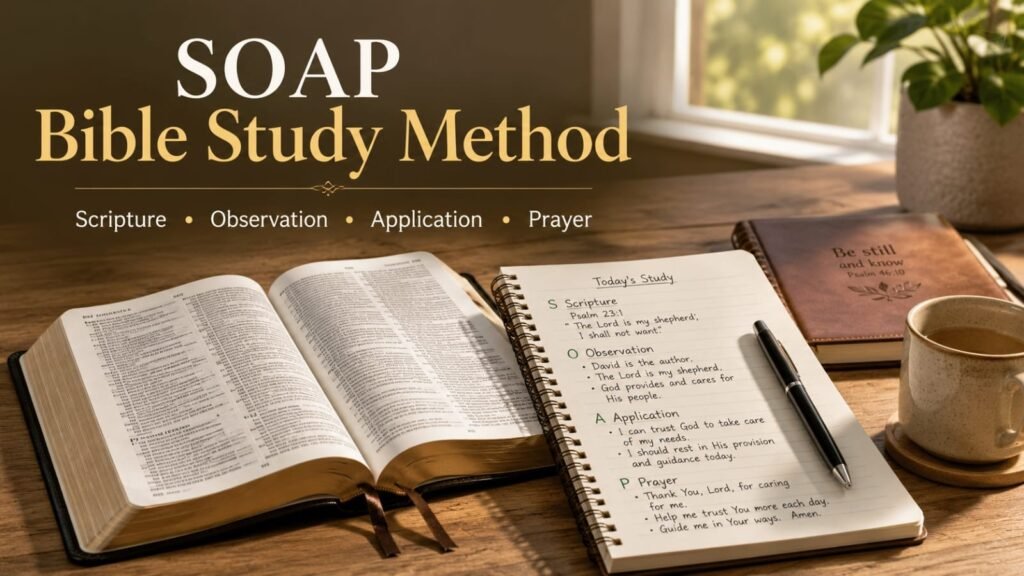
The SOAP Bible Study Method is a simple way to study Scripture using four steps: Scripture, Observation, Application, and Prayer. First, read and record a Bible passage. Then observe what the text says, apply its message to your life, and finish by responding to what you learned through prayer.
Key Takeaways
- SOAP stands for Scripture, Observation, Application, and Prayer.
- Each step has a different purpose in the study process.
- Good observation starts with what the passage actually says.
- Application should be specific rather than vague.
- Reading the surrounding context can help prevent misunderstandings.
- SOAP helps you move from simply reading Scripture to reflecting on and applying it.
Table of Contents
- What Is the SOAP Bible Study Method?
- What Does SOAP Stand For?
- How to Use the SOAP Method of Bible Study
- SOAP Bible Study Example
- Common Mistakes to Avoid
- Simple SOAP Bible Study Template
- Frequently Asked Questions
What Is the SOAP Bible Study Method?
Reading a Bible passage and actually knowing what to do with it are two different things. The SOAP Bible study method gives you a simple way to slow down, understand what you are reading, and connect Scripture with everyday life.
It can be especially helpful if you want more direction during personal Bible study but do not want a complicated system. You can start with a Bible, something to write with, and enough time to read the passage without rushing.
The method works best when you treat it as a guide rather than a checklist. SOAP should give your Bible study direction, not make it feel like another task you have to complete perfectly.
The four steps are Scripture, Observation, Application, and Prayer.
What Does SOAP Stand For?
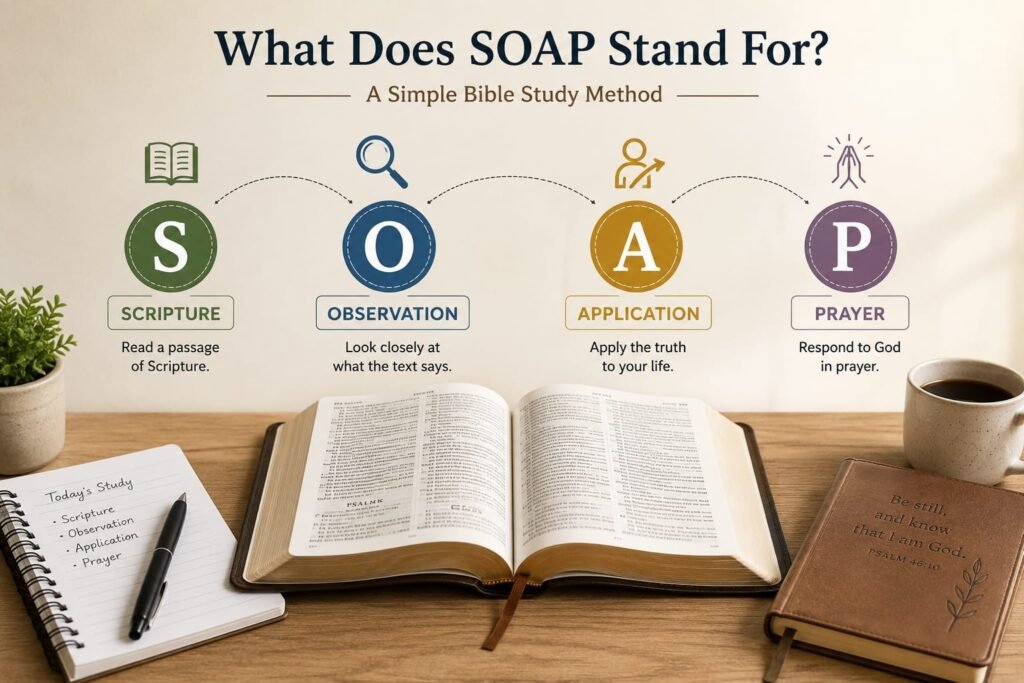
Before using the SOAP method, it helps to understand what each letter is asking you to do.
| SOAP Step | Main Focus | What to Ask | Common Mistakes |
| Scripture | Identify the passage | What am I studying? | Choosing a verse without context |
| Observation | Understand the text | What does it say? | Jumping straight to personal meaning |
| Application | Respond to the truth | What should change? | Making the application too vague |
| Prayer | Respond to God | How should I respond? | Treating prayer as an afterthought |
The four steps work together, but you do not have to rush from one to the next. Give yourself time to understand the passage before deciding how it applies to your life.
How to Use the SOAP Method of Bible Study
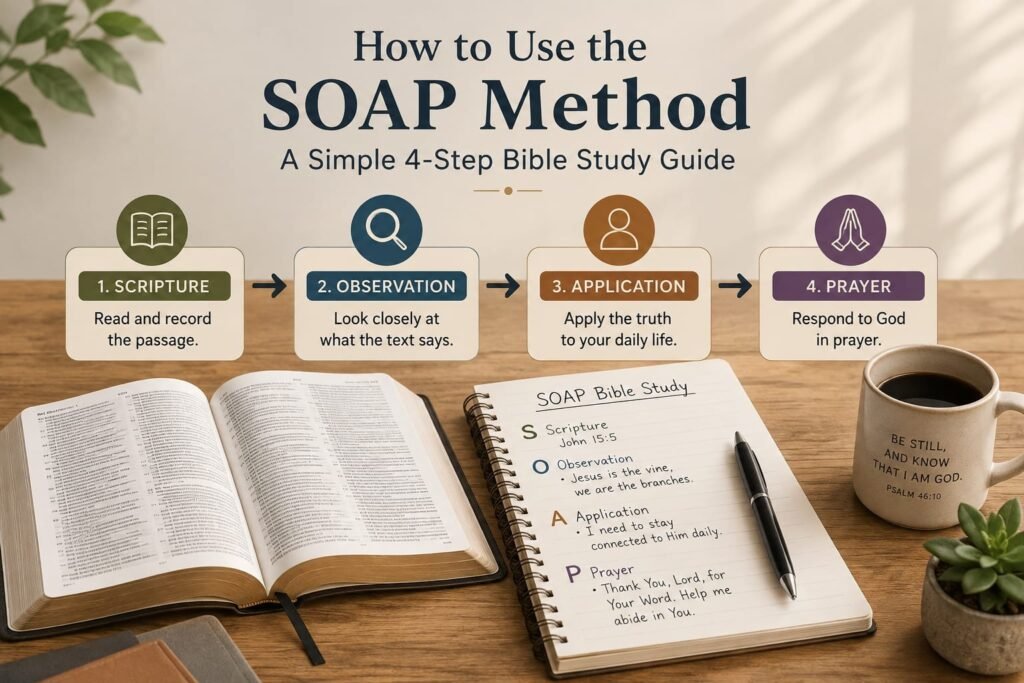
1. Scripture: Read and Record the Passage
Start by choosing a manageable section of the Bible. You can use a short passage from a reading plan, continue through a particular book, or select a few verses you want to study more carefully.
Read the passage slowly. If a verse stands out, write it down along with its reference. Writing down the verse gives you a specific passage to return to as you work through the other SOAP steps.
Do not worry about finding the perfect verse. The goal is to spend enough time with Scripture to understand it rather than simply collecting verses that sound encouraging.
2. Observation: Look Closely at the Text
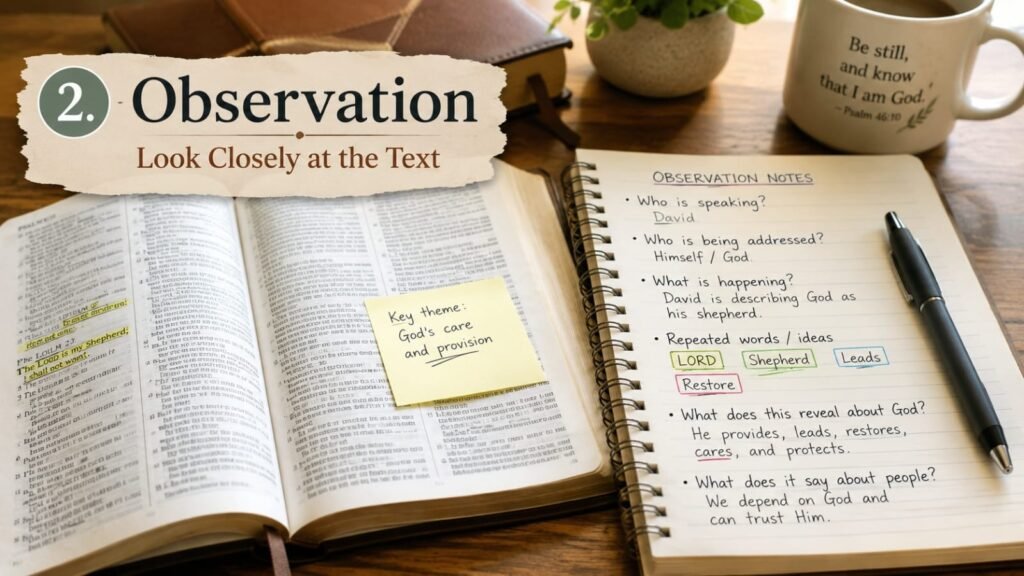
In the Observation step, slow down and look closely at the passage. Your first job is simply to understand what the text says.
Look for details that might be easy to miss during a quick reading. You might notice a repeated word, a command, a promise, a warning, a contrast, or a change in the speaker or situation.
Ask yourself:
- Who is speaking?
- Who is being addressed?
- What is happening?
- What words or ideas are repeated?
- Is there a command, promise, warning, or example?
- What does this passage reveal about God?
- What does it say about people or their behavior?
Context matters here. Read the verses before and after your selected passage when needed. BibleProject also encourages readers to approach Scripture as a unified story rather than treating individual lines as isolated statements.
| Pro Tip: Observe before you apply. Start with what the passage says, then consider what it means for your life. |
3. Application: Put the Truth Into Practice
Application moves the study from understanding the passage to deciding how its truth should shape your life. Ask yourself: What should I do with what I have learned?
Writing “I need to trust God more” may be true, but it does not tell you what you will actually do.
A stronger application is specific. If your passage teaches you to seek God’s wisdom, your application might be to pray for wisdom before making an important decision instead of immediately relying on your own assumptions.
Try asking:
- Is there something I need to believe?
- Is there an attitude I need to change?
- Is there a command I need to follow?
- Is there a habit I need to begin or stop?
- How can I put this lesson into practice today?
A practical approach is to choose one clear action rather than creating a long list of promises to yourself.
4. Prayer: Respond to What You Learned
Prayer is the final step. Use what you discovered in the passage as a starting point for your conversation with God.
You might thank God for something you learned, ask for help obeying a command, confess an attitude that needs to change, or ask for wisdom in a situation you are facing.
Prayer does not need to be long or complicated. It should be an honest response to what you have just studied.
SOAP Bible Study Method Example
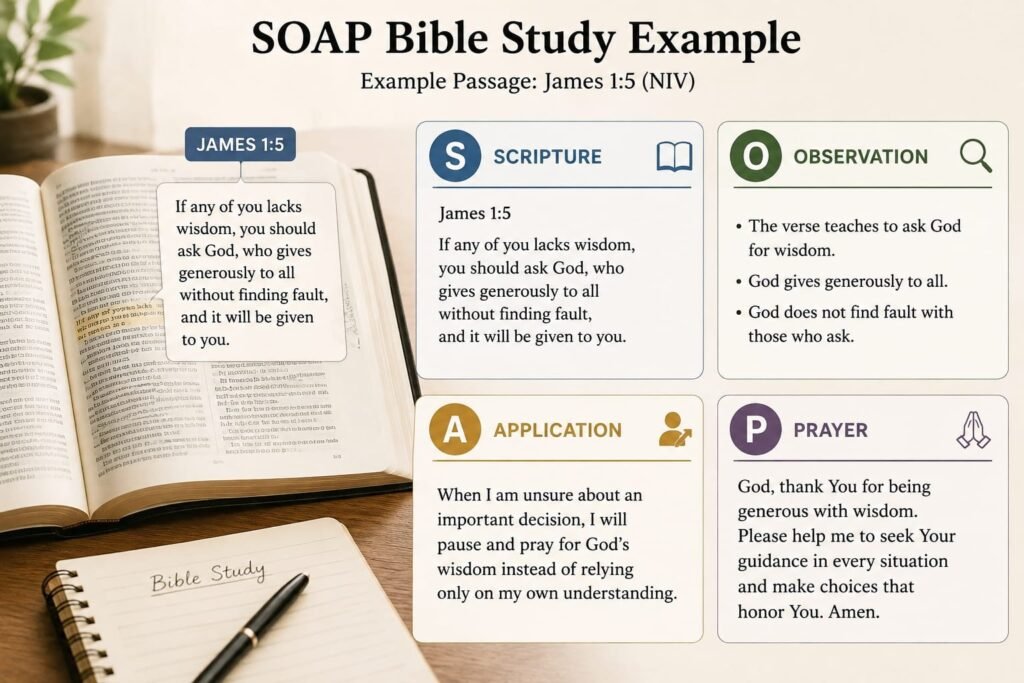
Let’s use James 1:5 as a simple example. The verse teaches that someone who lacks wisdom should ask God, who gives generously.
Scripture:
James 1:5. The passage focuses on asking God for wisdom when we lack it.
Observation:
The verse directly addresses a need for wisdom and points the reader toward God as the source of that wisdom. It also describes God as generous rather than reluctant to give.
Application:
When I am unsure about an important decision, I will pause and pray for wisdom instead of making the decision based only on fear, pressure, or my own assumptions.
Prayer:
Example prayer:
God, please give me wisdom when I am unsure what to do. Help me seek Your guidance and make choices with humility and faith.
Each part has a different job. Scripture identifies the passage, Observation stays close to the text, Application turns the lesson into a practical response, and Prayer brings that response to God.
Common Mistakes to Avoid
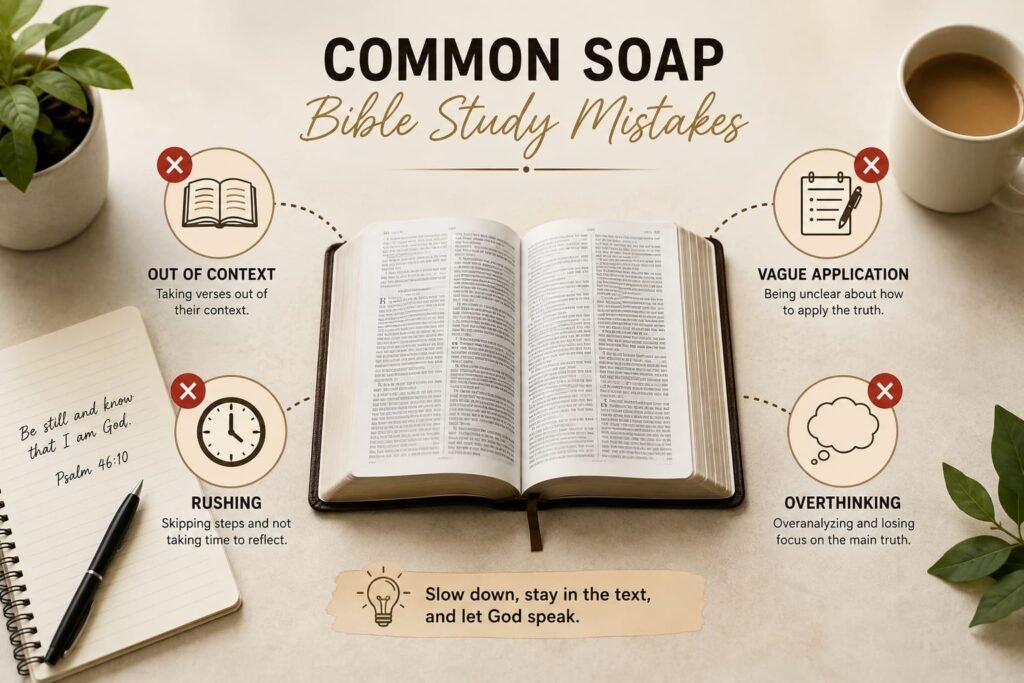
SOAP is simple, but a few common mistakes can make the study less useful.
Taking a verse out of context. A single sentence may not tell you the whole point of a passage. Read enough surrounding material to understand what is happening.
Confusing observation with application. Saying “I need to be more patient” is an application, not an observation. First identify what the passage says about patience, then decide what you should do about it.
Making applications too vague. “I will do better” is difficult to act on. A specific action gives you something you can actually remember and practice.
Trying to write too much. SOAP is not a competition to fill several journal pages. A few thoughtful observations can be more useful than a page of rushed notes.
Treating SOAP as a rigid formula. The method is there to help you study Scripture. If a passage needs more time for context or raises questions that require further study, take that time.
Simple SOAP Bible Study Method Template
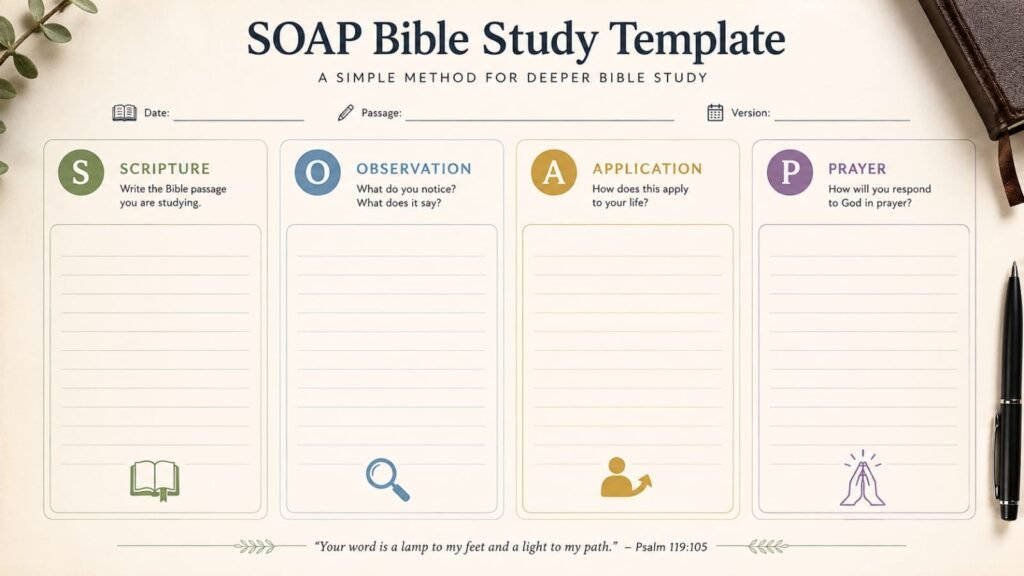
You can copy this format into a notebook, journal, or notes app:
Scripture:
Write the verse or passage you are studying.
Observation:
What do you notice? What does the passage teach about God, people, actions, or truth?
Application:
What is one specific way you can respond to this truth?
Prayer:
Write a short prayer based on what you learned.
Once you become comfortable with the method, you can add your own questions. Some people prefer to include a section for context, cross-references, or questions they want to research later.
Frequently Asked Questions
What is the SOAP Bible Study Method?
The SOAP Bible Study Method is a simple framework for studying Scripture through four steps: Scripture, Observation, Application, and Prayer. It helps you read a passage carefully, understand what it says, consider how its message applies to your life, and respond through prayer.
What does SOAP stand for in Bible study?
SOAP stands for Scripture, Observation, Application, and Prayer. Scripture focuses on the passage you are studying, Observation examines what the text says, Application connects its message to your life, and Prayer gives you an opportunity to respond to what you have learned.
How do you do a SOAP Bible study?
Start by choosing and reading a Bible passage. Write down the key Scripture, then observe important details such as repeated ideas, commands, promises, or warnings. Next, identify a specific way to apply what you learned. Finish by praying about the passage and your response to it.
What should I write in the Observation section?
Write down what you notice in the passage without immediately turning it into a personal application. Look for repeated words, important details, commands, promises, warnings, contrasts, and what the passage reveals about God or people. Reading the surrounding verses can also help you understand the passage in context.
How do you apply a Bible verse using the SOAP method?
Ask yourself how the truth in the passage should affect your thoughts, attitudes, choices, or actions. Try to make your application specific. Instead of writing, “I need to trust God more,” identify one practical step you can take to demonstrate that trust in a situation you are facing.
Is the SOAP method a good way to study the Bible?
Yes. The SOAP method can be a helpful starting point, especially for people who want a simple structure for personal Bible study. It encourages you to slow down, examine Scripture carefully, think about its practical meaning, and respond through prayer. It is a framework rather than a strict formula, so you can adapt it as you grow in your study.
Conclusion
The SOAP Bible study method gives you a practical structure for slowing down, understanding Scripture, and turning what you learn into a thoughtful response.
You do not need complicated materials to begin. Pick a short passage, open a notebook, and work through the four steps. As you practice, you can adjust the questions and add deeper study when a passage calls for it.