Does the Comma Come Before or After “And”?
The comma usually comes before “and” when “and” joins two independent clauses. If “and” connects words, phrases, or verbs with the same subject, you generally do not need a comma. A comma can appear after “and” when an interrupting or parenthetical phrase follows it.
Key Takeaways
- Use a comma before and when it connects two independent clauses.
- Do not automatically add a comma before every and.
- A comma after and is possible when an interrupting expression follows it.
- In a list of three or more items, the Oxford comma may appear before and.
- The easiest way to choose is to examine what and is connecting.
Table of Contents
- Does the Comma Come Before or After “And”?
- When Should You Put a Comma Before “And”?
- When Should You Not Put a Comma Before “And”?
- Can a Comma Come After “And”?
- What About the Comma Before “And” in a List?
- A Simple Test for Choosing the Right Comma
- Comma Before or After “And”: Examples
- Common Mistakes to Avoid
- FAQs
Does the Comma Come Before or After “And”?
If you are wondering whether the comma comes before or after “and,” the answer depends on what the word is connecting.
In most cases, a comma comes before “and” when it joins two independent clauses, the comma comes before it:
|I finished my assignment, and I submitted it before the deadline.
Here, both sides could stand alone as sentences:
- I finished my assignment.
- I submitted it before the deadline.
However, if and connects two verbs, words, or phrases, you normally do not need a comma:
|She opened the book and started reading.
So, the position of the comma is not determined by the word and itself. The important question is what the conjunction is joining.
When Should You Put a Comma Before “And”?
The most common situation is when and joins two independent clauses. An independent clause contains a subject and a verb and can function as a complete sentence.
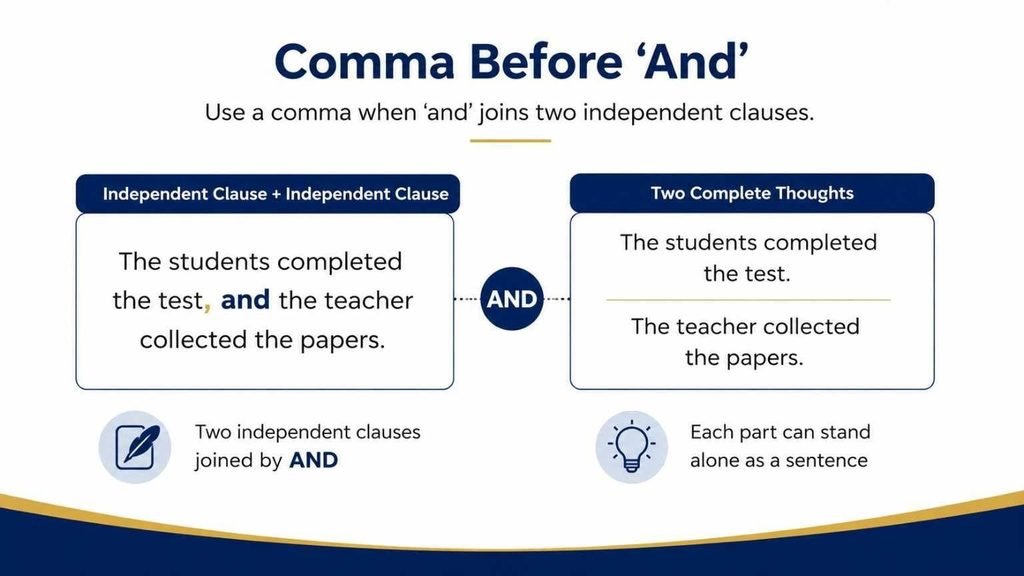
For example:
The students completed the test, and the teacher collected their papers.
The first clause is complete: “The students completed the test.” The second is also complete: “The teacher collected their papers.”
The comma separates the two independent clauses, making the boundary between the two thoughts clear.
The Purdue OWL explains the same basic pattern: an independent clause followed by a coordinating conjunction and another independent clause takes a comma before the conjunction.
When the Two Clauses Have Different Subjects
When “and” joins two independent clauses, you will often see a different subject in the second clause:
Maria prepared the presentation, and James checked the slides.
The two clauses have different subjects, Maria and James, and each has its own verb.
My simplest rule is this: if both sides of “and” can stand alone as complete sentences, you probably need a comma before “and.”
When the Sentence Contains Two Complete Thoughts
Sometimes the two ideas are closely related, but they are still grammatically independent:
The weather changed suddenly, and we decided to leave.
Without the comma, the sentence can become harder to scan, especially when both clauses are relatively long.
Quick tip: Do not decide based only on where you would pause while speaking. Look at the grammatical structure of the sentence first.
When Should You Not Put a Comma Before “And”?
The phrase comma before or after and can be confusing because many writers assume that every and requires punctuation. It does not.
When and connects two verbs that share the same subject, you normally do not use a comma:
Daniel opened the door and walked inside.
Texas A&M University Writing Center notes that a comma is not needed when the coordinating conjunction does not join two independent clauses.
The subject “Daniel” applies to both actions. The sentence is not joining two independent clauses.
Compare it with this:
Daniel opened the door, and he walked inside.
Now the second clause has its own subject, “he,” and can stand independently. The comma is appropriate because and is connecting two independent clauses.
The same principle applies when and connects words or phrases:
She bought apples and oranges.
The movie was long and boring.
We can meet in the morning or afternoon.
There is no reason to insert a comma simply because two items are connected.
A Useful Comparison
| Structure | Example | Comma before “and”? |
| Two independent clauses | I called him, and he answered. | Yes |
| Two verbs, same subject | I called him and left a message. | Usually no |
| Two nouns | Sarah and Michael arrived. | No |
| Two adjectives | The test was difficult and lengthy. | No |
| Three or more items | I brought bread, milk, and eggs. | Oxford comma, optional by style |
This distinction is one of the easiest ways to avoid unnecessary commas.
Can a Comma Come After “And”?
Yes, but a comma after “and” is much less common than a comma before it.
You should not normally write:
I finished my work and, went home.
That comma is incorrect because there is no grammatical reason to separate and from the verb that follows it.
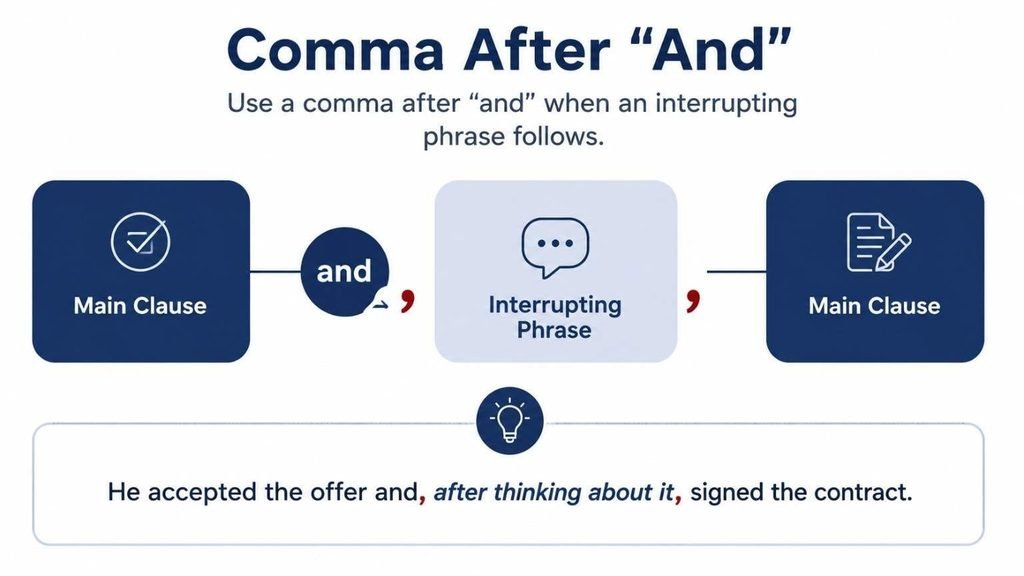
A comma can appear after and when an interrupting or parenthetical expression comes next:
I finished my work and, after checking it twice, sent it to my manager.
“After checking it twice” is an interrupting phrase, so it is set off with commas .
Another example is:
She agreed to help and, in fact, offered to stay late.
Here, “in fact” is an interrupting expression. The comma after and belongs to the pair of commas surrounding that expression.
This is why it is better to think about the whole sentence rather than memorizing “comma before and” or “comma after and” as a fixed rule.
What About the Comma Before “And” in a List?
There is another common situation where you may see a comma before and: a list of three or more items.
For example:
I packed a notebook, a pen, and a laptop.
The comma immediately before and is called the Oxford comma, or serial comma.
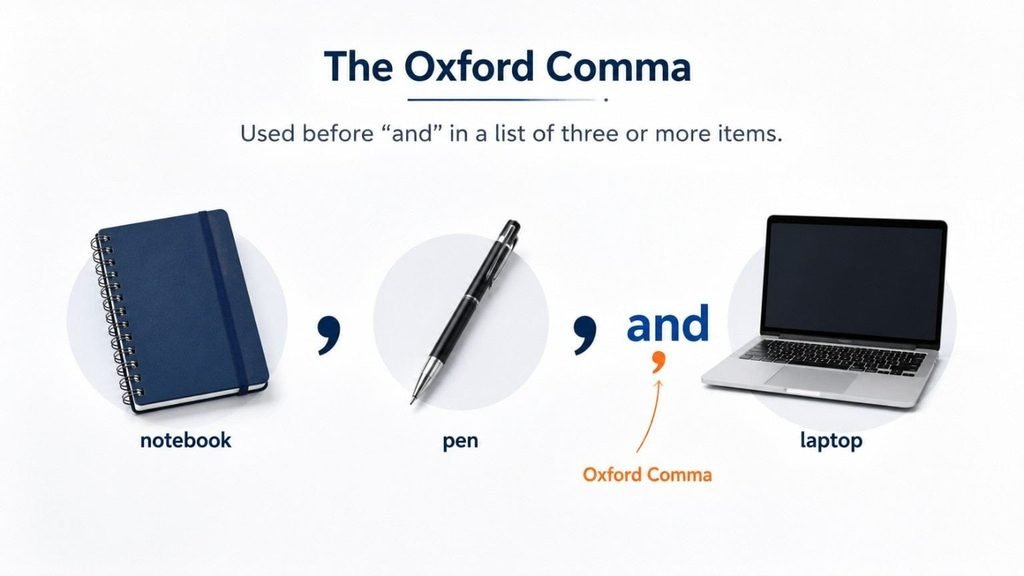
Google’s developer style guide recommends using the serial comma in lists of three or more items to reduce ambiguity.
Style guides differ on whether the Oxford comma is required, so check the style guide you are writing for and use one approach consistently.
I packed a notebook, a pen and a laptop.
Both styles are commonly seen in American English. The important thing is to follow the style requirements of the publication or organization you are writing for and remain consistent.
The Oxford comma can also make a sentence easier to understand when the list contains complicated items:
The course covers grammar, punctuation, and sentence structure.
Here, the final comma creates a clear visual separation between the last two items.
Oxford Comma vs. Compound Sentence
Do not confuse these two situations.
List:
We studied grammar, punctuation, and vocabulary.
Two independent clauses:
We studied grammar, and we practiced the exercises.
The first uses a comma because and introduces the final item in a list. The second uses a comma because and connects two independent clauses.
The comma may look similar, but the grammatical reason behind it is different.
A Simple Test for Choosing the Right Comma
If you are still unsure does the comma come before or after and, use this three-step test.
Step 1: Identify what “and” connects.
Look at the words or clauses on both sides of and.
Step 2: Ask whether both sides can stand alone as sentences.
Ask whether each side could be written as a complete sentence.
For example:
The meeting ended.
Everyone left.
Both are complete, so combining them gives:
The meeting ended, and everyone left.
Step 3: Check for an interruption after “and.”
If an interrupting phrase comes immediately after and, it may need commas:
The meeting ended and, after a short discussion, everyone left.
This method works better than simply trying to remember where the comma “sounds right.”
Comma Before or After “And”: Examples
Here are several examples that show the difference clearly.
Comma before “and”:
The store was closing, and we needed to hurry.
Both parts can stand independently.
No comma:
We hurried to the store and bought the supplies.
The same subject performs both actions.
No comma in a simple list:
She bought a notebook and a folder.
Only two items are being connected.
Oxford comma:
She bought a notebook, a folder, and a calculator.
The comma before and separates the final item in a three-item list.
Comma after “and”:
He accepted the offer and, after thinking about it, signed the contract.
The phrase “after thinking about it” interrupts the sentence.
Incorrect unnecessary comma:
She opened the laptop and, started working.
There is no interrupting expression, so the comma after and should be removed.
Common Mistakes to Avoid
One common mistake is putting a comma before every and. The word itself does not automatically require punctuation.
Another mistake is adding a comma after and because the writer feels there should be a pause. In most ordinary constructions, that comma is unnecessary.
It is also easy to confuse a list with a compound sentence. Before adding punctuation, ask yourself whether and is connecting individual items or two independent clauses.
Finally, do not rely entirely on speech. A pause in conversation does not always correspond to a comma in writing. Grammar and sentence structure should guide the decision.
Another common mistake is confusing the Oxford comma with the comma used between independent clauses. Both commas appear before “and,” but they serve different purposes. In a list, the comma separates the final item. In a compound sentence, it separates two independent clauses.
FAQs
Does the comma come before or after “and”?
A comma usually comes before “and” when it joins two independent clauses. A comma after “and” is less common and usually appears when an interrupting phrase follows it. If “and” connects words, phrases, or verbs with the same subject, no comma is normally needed.
Is there ever a comma after “and”?
Yes. A comma can come after and when an interrupting or parenthetical expression follows it. For example: “She agreed and, after a short discussion, changed her answer.”
Do you put a comma before “and” in a list?
You may use a comma before and in a list of three or more items. This is known as the Oxford comma. Whether it is required depends on the style guide being followed.
What is the Oxford comma?
The Oxford comma is the comma placed before and or or before the final item in a list of three or more items. For example: “I bought tea, coffee, and sugar.”
Can you start a sentence with “And”?
Yes. Starting a sentence with And is grammatically acceptable when it is used intentionally and the sentence is clear. It is not necessary to avoid the practice simply because of an old writing rule.
How do I know if I need a comma before “and”?
First, check what and connects. If it joins two independent clauses, a comma usually comes before it. If it joins words, phrases, or verbs with the same subject, you generally do not need one.
Conclusion
When you are deciding whether the comma comes before or after “and,” focus on what the conjunction is connecting rather than the word “and” itself.
If and joins two independent clauses, a comma usually comes before it. If it connects words, phrases, or two actions with the same subject, a comma is generally unnecessary. A comma can appear after and when an interrupting expression follows.
Once you identify what and is connecting, the comma decision becomes much easier.