
Learn Smarter. Write Better.
The blurting study method is an active recall technique where you study a specific topic, close your notes, and write down everything you can remember without looking back. You then compare your response with the original material, identify what you missed or misunderstood, and review those weak areas before testing yourself again.
If you have ever reread the same notes several times and still struggled to explain the topic without looking at the page, blurting offers a useful alternative.
The basic idea is simple. Study first, hide the information, then retrieve it from memory. Instead of asking yourself whether the notes look familiar, you test whether you can actually produce the information yourself
That makes blurting a form of active recall. Birmingham City University also describes blurting as a form of active recall in which students study a topic, hide their notes, and write down what they remember.
The method does not require an app, special cards, or elaborate preparation. A topic, your study material, and a blank page are enough.
Key Tip: The goal of blurting is not to create beautiful notes. It is to find out what you can remember without help.
Blurting relies on retrieval practice, which means deliberately bringing previously studied information back to mind instead of simply reading it again.
Research on retrieval practice has found benefits for learning across different educational settings and content areas. One systematic review of 50 classroom experiments found that retrieval practice generally improved learning across a range of conditions, although its effectiveness can vary depending on the material, timing, and feedback provided.
This is where the checking stage becomes important. Suppose you remember eight key points but miss four. Those four missing points are useful information. They tell you where your knowledge is weaker
I recommend treating the first blurt as a diagnostic test, not as a final measure of how well you know the topic. The point is to turn the results into your next study action.
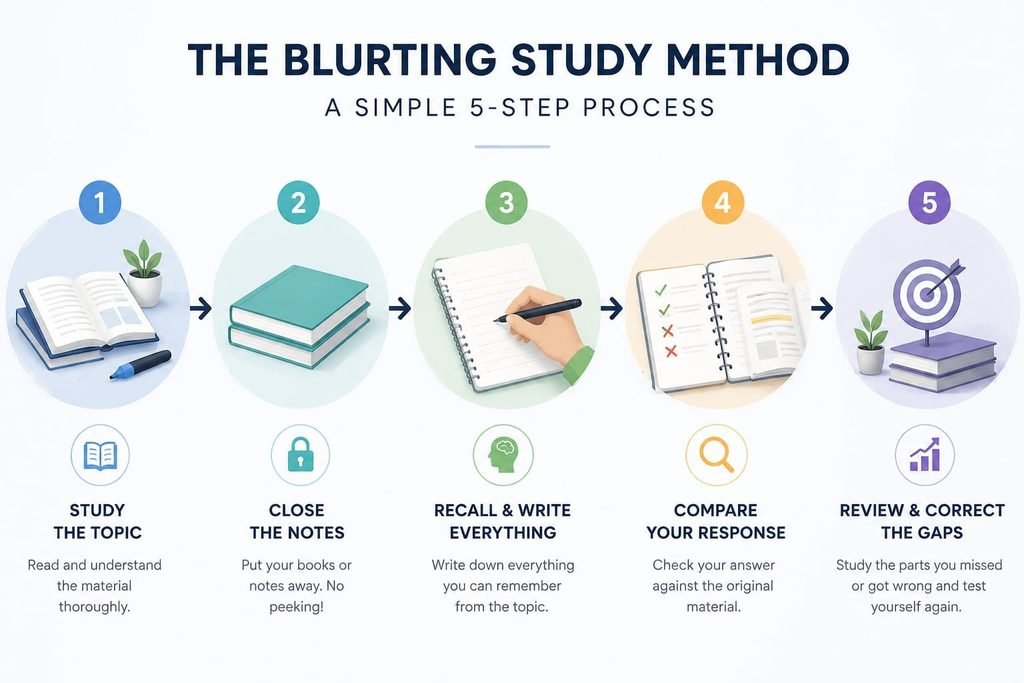
Start with one manageable section rather than an entire textbook.
For example, instead of blurting everything from a biology course, choose cell division or the stages of mitosis. A focused topic makes it easier to see exactly what you know.
Read your notes, textbook section, or other reliable study material carefully. Your goal at this stage is to understand the topic rather than memorize every sentence.
Once you have finished the initial review, put the material away.
Take a blank sheet of paper and write down everything you can recall.
Do not stop to make the page neat. You can write definitions, examples, key terms, processes, causes, effects, formulas, or connections between ideas.
The important rule is simple: do not look at your notes while recalling.
Now bring the original material back.
Go through your response and identify three things:
| What you wrote | What it tells you | What to do |
| Correct information | You recalled it successfully | Move on or test it later |
| Partly correct information | Your understanding needs clarification | Review and correct it |
| Missing information | You could not retrieve it | Study and test it again |
This comparison is one of the most valuable parts of the blurting study method. Without it, you may simply be writing down what you remember without learning from the gaps.
Return to the information you missed. Read it again, explain it in your own words, and then close the notes.
Try recalling the same point again.
If you made a factual mistake, correct it rather than repeatedly memorizing the incorrect version.
Do not assume one successful blurt means the topic is permanently learned.
Return to the material after some time and test yourself again. Spacing your retrieval attempts across time can make revision more deliberate, and research has examined how spacing and retrieval practice work together to support learning. Nature Review Psychology
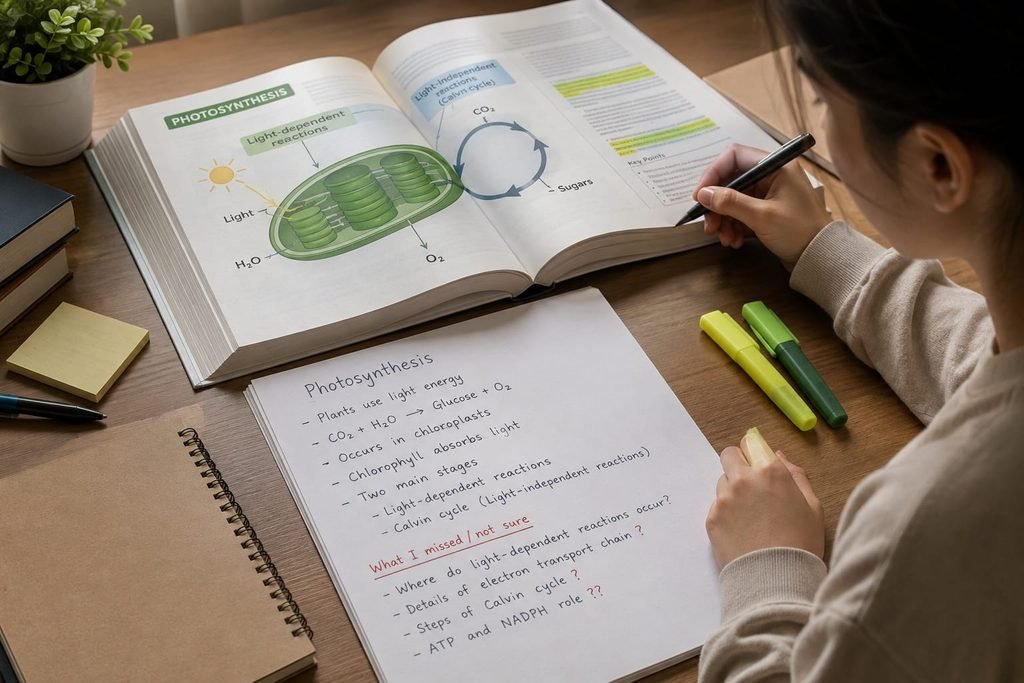
Imagine you are studying photosynthesis for a biology exam.
After reviewing the topic, close your textbook and write everything you remember. You might recall that plants use light energy, carbon dioxide, and water to produce glucose and oxygen. You might also remember that chlorophyll is involved.
When you compare your answer with your notes, you discover that you forgot where the light-dependent reactions occur and could not explain the Calvin cycle.
That gives you a much clearer study plan.
Instead of rereading the entire chapter, you can focus on those weaker areas, then close your notes and try to explain them again.
This is where I find blurting most useful. It turns vague feelings about your progress into specific information about what you need to study next.
Blurting is useful because it makes you retrieve information instead of simply recognizing it on a page. It can also expose knowledge gaps quickly and requires very little equipment.
However, it is not a complete study system on its own.
For example, if you have not understood a difficult concept in the first place, immediately blurting it may only show that you cannot recall it. In that situation, you need to return to learning and understanding the material before testing yourself again.
Retrieval practice can be particularly useful when learners receive appropriate feedback, although its relative benefit can vary depending on the learning task and what it is compared with. Annual Review of Psychology
For that reason, I recommend using blurting as part of a broader study routine rather than using it for every task.
Blurting works best when you adapt it to the type of information you are studying. The goal is not always to reproduce a page of notes. Instead, change what you recall based on what the subject requires.
Biology: Recall processes, definitions, functions, and relationships between concepts. After blurting, use diagrams or practice questions to check whether you understand the process, not just the terminology.
History: Try recalling major events, causes, consequences, important people, and connections between events. This can help you see whether you understand the sequence rather than simply recognizing names and dates.
Psychology: Blurt theories, key concepts, studies, and explanations in your own words. Then check your notes for missing details or inaccurate connections.
Mathematics: Blurting can help with formulas, definitions, and problem-solving steps, but it should not replace actually solving problems. After recalling the relevant rules, test yourself with practice questions
These methods can all have a place in revision, but they ask you to interact with information differently.
| Study method | Main action | Best use |
| Blurting | Recall everything from memory | Finding knowledge gaps |
| Rereading | Review the material again | Initial understanding or clarification |
| Flashcards | Retrieve specific answers to prompts | Facts, definitions, and short concepts |
| Practice questions | Produce answers to exam-style prompts | Applying knowledge and exam preparation |
Blurting is particularly useful when you want a quick overview of what you actually remember about a whole topic. Flashcards are more targeted, while practice questions can show whether you can use your knowledge in the form an exam may require.
A few habits can make blurting less useful than it should be.
Looking at your notes too soon: The moment you check the answer while recalling, you reduce the challenge that makes retrieval practice useful.
Trying to make the page perfect: A blurt is not a revision poster. Focus on recall rather than handwriting, formatting, or organization.
Skipping the comparison stage: This is one of the biggest mistakes. You need to check what you remembered against a reliable source so that you can identify gaps and correct errors.
Studying only what you already know: Once you find the gaps, spend your next review session on them. Otherwise, blurting becomes a test without a follow-up learning step.
Using it only once: One successful recall attempt does not mean you will remember the material weeks later. Bring the topic back into your study schedule.
Remember: A weak first blurt can actually be useful. It gives you a map of what needs attention instead of leaving you to guess which topics you should revise.
Blurting can be a useful way to practice retrieval and identify gaps in your knowledge. Research on retrieval practice supports its value across many educational settings, but it works best when you check your answers and use the feedback to guide further study.
There is no universal time limit. The right amount depends on the size and difficulty of the topic. A short, focused session is often more useful than trying to produce a huge amount of information at once.
You can adapt it to many subjects, especially those involving facts, concepts, processes, and explanations. For subjects that require substantial problem solving, such as mathematics, combine blurting with worked examples and practice questions.
Do not simply keep staring at the blank page. Return to your study material, identify the specific concept you struggled with, understand it, and then attempt the recall again.
Blurting and rereading serve different purposes. Rereading can help you review or understand material, while blurting tests whether you can retrieve it without support. Retrieval practice has substantial research support, but it should be used alongside other appropriate learning activities rather than treated as a universal replacement.
Yes. It can help you identify which parts of a topic you can recall and which ones still need work. For exam preparation, I recommend combining it with practice questions so you test both recall and application.
The blurting study method is simple by design. Learn a manageable topic, put your notes away, recall what you can, check the result, and use the gaps to decide what to study next.
Its real value is not the messy page you produce. It is the honest feedback that page gives you.
Use blurting alongside spaced review, practice questions, and other suitable study methods, and let your results guide where you spend your study time. That makes revision more deliberate and helps replace the question “Do I recognize this?” with the more useful question: “Can I recall and explain it without looking?”