How to Annotate an Article for Better Reading and Understanding
Imagine spending forty-five minutes reading a detailed article, closing the tab or laying down the paper, and realizing you cannot recall a single main point. You look back at the pages, and they are covered in bright yellow ink, yet your mind is completely blank. Highlighting alone creates a dangerous illusion of learning because dragging a color marker across a sentence feels like work, but it leaves your brain on autopilot.
Real comprehension requires active engagement, and that is where annotation transforms how you read. Annotation is not decorative marking; it is an active, ongoing conversation with the author where you dissect arguments, challenge claims, and record your actual thought process directly on the page.
When done correctly, annotations convert a static document into a clear, personalized reference map that saves you hours of re-reading. This guide provides a complete, step-by-step system to help you spot critical arguments, write purposeful margin notes, avoid over-highlighting, and extract maximum value from any complex text.
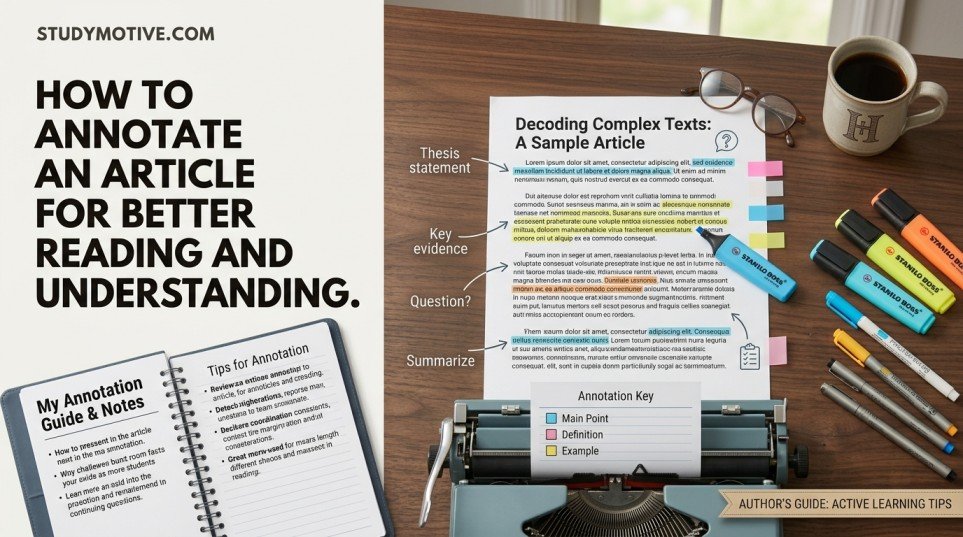
What Does It Mean to Annotate an Article?
Annotating an article means turning passive reading into an active conversation with the text. It requires you to process information as you read rather than just running your eyes over the printed words.
A proper annotation process involves several specific actions that work together. You might highlight critical statements, jot short analytical notes in the margins, define unknown terms right where they appear, write down spontaneous questions about the logic, or summarize complex sections into brief phrases.
There is a major difference between simple text marking and true annotation. Highlighting merely flags a sentence for later, while annotating records your actual thinking process.
For example, consider a line like students who sleep adequately tend to perform better academically. A basic reader might just yellow-highlight the sentence and move on. A thoughtful annotator highlights the line and writes key evidence for sleep argument in the margin. That short note proves you actually understood why the statement mattered to the overall piece.
What Should You Look for When Annotating an Article?
To annotate effectively, you must know what deserves your attention before you even start reading. Searching for specific text elements keeps your mind focused and prevents aimless reading.
First, you need to identify the primary subject and the author’s core argument. Look for overarching statements in the opening section that define the topic, and pinpoint the exact position the writer wants you to accept. This central claim drives the entire piece forward.
Second, pay close attention to supporting evidence and critical terminology. Track how the writer proves their points across the body paragraphs through raw numerical statistics, peer-reviewed study references, historical examples, or expert quotes. Whenever specialized terminology or key technical concepts appear, mark them immediately.
Finally, stay alert for questions, unclear logic, and conceptual connections. Notice where the reasoning feels incomplete so you can research it later. At the same time, look for relationships hidden within the text where new facts connect to earlier paragraphs or your own prior knowledge.
How to Annotate an Article Step by Step
1. Read the Article Once Before Marking It
Do not start highlighting during your very first pass through the text. Read the article through once simply to grasp the general context and overall structure.
During this initial read, ask yourself what the main topic is, what the writer is trying to prove, and how the information is organized. First-time reading sets a baseline for your brain and prevents you from accidentally highlighting details that later turn out to be minor background information.
2. Identify the Author’s Main Argument
Separate the general topic from the specific point the author wants to prove. The topic is simply what the text is about, while the argument is the writer’s specific stance on that topic.
For instance, social media platforms is merely a general topic. The argument is that excessive social media use reduces adolescent sleep quality and attention span. Focus your energy on locating that specific claim sentence, which usually sits near the end of the introductory section.
3. Mark the Evidence That Supports the Argument
Once you spot the main claim, search for the facts used to hold it up. You want to mark only the strongest evidence, not every casual sentence.
Ask yourself how a specific fact proves the main point. If the text presents a survey result showing an 80 percent decline in focus, mark that specific statistic as primary proof.
4. Mark Important Explanations and Examples
Not every critical passage functions as direct evidence. Writers spend significant time explaining how things work or setting up background context.
Look for paragraphs that define hard concepts or offer clear analogies. These passages explain the underlying mechanics of the argument and make complex ideas easier to remember later.
5. Write Short Notes in the Margins
Keep your margin notes brief and direct. Writing long sentences takes too much time and clutters the physical page.
Use concise anchor phrases in your margins such as main claim, core evidence, key example, cause and effect, weak logic, or links to intro. Short labels serve as quick signposts when you return to scan the document later.
6. Mark Questions and Confusing Passages
Writing down your confusion is a sign of strong active reading, not failure. When a paragraph feels dense or illogical, place a question mark beside it.
Margin questions like where is the source for this stat? or what does this term mean here? give you a specific checklist of items to resolve later.
7. Summarize Each Major Section in Your Own Words
Pause at the end of each major sub-section or long block of text. Write a brief single-sentence summary of that specific block right in the margin.
Forcing yourself to restate the information in your own words tests whether you truly understood the material or just read the words passively.
8. Review the Annotations After Reading
Your work is not finished when you reach the final sentence. Take two minutes to scan back through all your highlighted phrases and handwritten margin notes.
Check if your notes clearly show how the argument develops from start to finish. If your margin summary tells a logical story, your annotation effort was a success.
What Should You Highlight When Annotating an Article?
Highlighting requires strict discipline. If you color too much of the page, the important facts will bleed together and become impossible to spot quickly.
Prioritize your highlighter for the primary thesis sentence, high-value statistical findings, essential technical definitions, and crucial takeaway conclusions. You should deliberately avoid highlighting general background history, conversational transition sentences, and minor side details.
A great rule of thumb is that if an entire paragraph is highlighted, nothing actually stands out. The goal is to make key facts pop off the page instantly.
What Should You Write in the Margins of an Article?
Beginners often struggle with margin space because they do not know what to write. Categorize your thoughts into distinct intent types as you read through the text.
To identify core ideas, write phrases like core thesis, key shift, or major takeaway. To analyze quality, note labels such as strong proof, unsupported claim, or biased source.
When questioning logic, write direct prompts like why this trend? or is this accurate?. To build connections, write quick references like matches 2024 study or applies to local market. Always ensure your notes add real meaning to the words rather than generic tags like important.
How Do You Identify the Main Argument in an Article?
Finding the argument requires tracking how the writer builds their thesis layer by layer. Every structured article follows a natural logical progression moving from topic to main idea, central claim, reasoning, evidence, and final conclusion.
Do not confuse the basic topic with the main argument. Consider an article focused on online learning models. The topic is simply online learning. The central claim is that online learning improves educational access for non-traditional working students.
The argument always takes a clear side or offers a distinct interpretation of facts. Look for signal words like therefore, consequently, argues, or suggests to locate the central thesis statement.
How Much of an Article Should You Annotate?
Good annotation is strictly selective. Your finished page should look clean, with clear white space surrounding target notes and neat underlined phrases.
Instead of counting how many marks you make per page, test the value of each mark. Ask yourself if flagging a line will help you explain, recall, or use the article later. If the answer is no, leave the text completely clean because less clutter makes your key insights much easier to find during review.
How to Annotate an Article for an Essay or Assignment
When reading an article to write a paper later, your annotation strategy must change. You are no longer just trying to understand the text; you are looking for usable material for your own writing.
Focus your marking on direct quotes that state a point perfectly, strong data points that prove your planned thesis, alternative viewpoints you need to address, and specific sentences that will require formal citation.
Write down why a passage is useful directly in the margin. A note reading use this quote in section two to show cost impacts turns your annotated article into an instant outline for your paper.
How to Annotate a Difficult or Academic Article
Dense academic papers packed with heavy terminology can feel overwhelming. Break down intimidating text by reading with a step-by-step questioning approach.
When facing a complex paragraph, isolate it and answer four basic questions in the margin. Determine what exact point the author is making in simple words, what specific evidence is being used, why the point matters, and how it connects to the overall argument.
If a sentence is filled with jargon, translate it into plain, conversational English in the margin immediately. Simplifying dense phrases on the spot keeps your momentum going through tough texts.
Annotated Article Example: What Good Annotations Look Like
Seeing real annotations helps put these principles into practice. Consider this sample text on urban planning:
Recent municipal transit data indicates that expanding dedicated bus lanes by 35 percent reduces overall morning commute times by 12 minutes per driver. While initial road construction causes brief traffic delays, the long-term reduction in city congestion proves that public infrastructure investments yield measurable economic productivity gains for suburban workers.
A complete annotation of that short paragraph extracts value step by step. You would highlight the core statistic expanding dedicated bus lanes by 35 percent reduces overall morning commute times by 12 minutes.
In the margins, you would add an evidence note like hard data showing bus lanes cut drive times, followed by an analytical note stating short-term disruption worth long-term speed gains. Finally, write a one-sentence summary at the bottom noting that bus lane expansions cost time upfront but boost long-term transit speed and economic output. You can review those notes weeks later and understand the whole point in five seconds.
How to Annotate an Article on a Computer or PDF
Digital annotation relies on the exact same core thinking skills as physical paper and pen. The digital interface changes, but your goals remain identical.
Use digital tools purposefully to replicate paper annotation. Apply standard highlight tools with restraint to avoid screen clutter, attach digital comment boxes directly to specific phrases for margin notes, use strikethrough features to flag background filler, and bookmark crucial pages for quick navigation across long PDFs.
Do not let software features distract you from critical thinking. Adding a digital note still requires you to process, analyze, and summarize what you just read.
How Do You Know If Your Annotations Are Useful?
You can easily test the quality of your finished annotations with a quick self-check. Cover the main text and read only your handwritten margin notes and highlighted phrases.
Ask yourself if you can explain the main point of the article, list the primary supporting facts, identify weak logic, and explain the piece without re-reading whole paragraphs.
If you can confidently answer those questions using only your notes, your annotations are successful. You have converted passive text into active, useful knowledge.
Frequently Asked Questions About Annotating an Article
Is highlighting an article the same as annotating it?
Highlighting is merely flagging text for later review. Annotating requires writing original notes, asking critical questions, and analyzing ideas directly on the page.
What should I annotate in an article?
Focus your effort on central claims, key statistical evidence, important terminology, confusing sections, logical connections, and brief structural summaries.
How much should I highlight when annotating?
Highlight selectively by focusing only on core thesis points and essential facts. Avoid coloring broad background information or entire paragraphs.
What should I write in the margins?
Write brief analytical labels, quick questions, translations of hard terms, and simple one-sentence summaries of complex sections.
How do I annotate an article for an essay?
Mark usable direct quotes, key supporting facts, and counterarguments. Note exactly how and where you plan to use each piece of data in your paper.
Should I read an article before annotating it?
Reading the article once through without marking gives you the overall context needed to make smart, selective annotations during your second pass.