How to Write an Effective Hook for an Argumentative Essay
Creating a strong hook is often the hardest part of drafting an argumentative essay. Many writers get stuck on the very first sentence because they try to capture attention without knowing where their argument is going. An effective hook does not just catch the eye of a reader. It introduces a specific debate, establishes an engaging tone, and sets up the central problem that your thesis will resolve.
The opening line forms the first link in a logical chain. It connects directly to your background information, which then narrows down to your thesis statement. When these elements work together, the introduction moves smoothly from a broad issue to a clear position.
An attention grabbing line that fails to connect with your thesis weakens the entire paper. Starting with a dramatic statement about space exploration when your essay focuses on local plastic recycling confuses the reader. A great opening line acts as an invitation to a specific conversation, giving your audience a clear reason to keep reading.
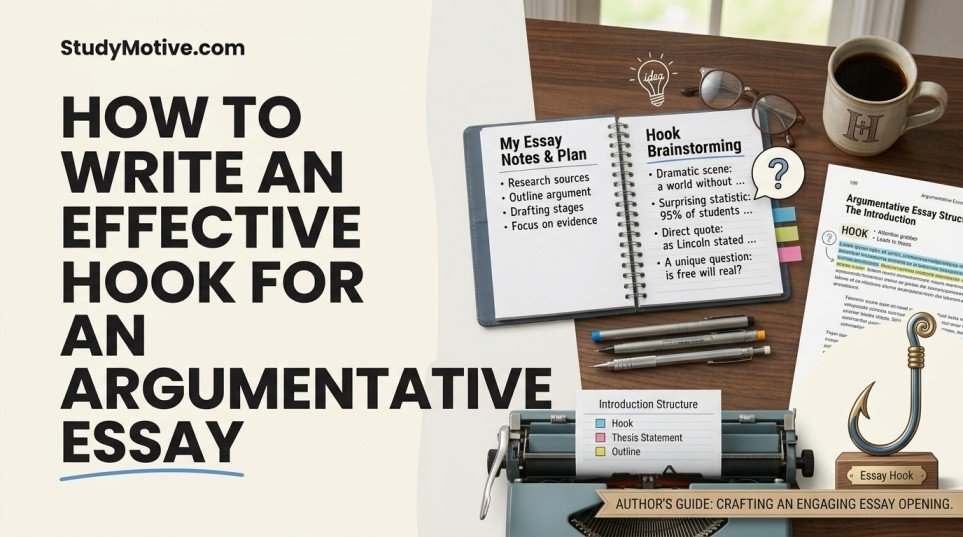
What Makes a Good Hook for an Argumentative Essay?
A successful hook must be relevant to your core argument. It needs to target the specific issue you plan to analyze rather than a broad subject area. Broad generalizations fail to engage readers because they do not present a real problem or an interesting angle.
Specificity gives your opening sentence its power. A sharp observation about a particular policy or trend creates instant interest. It signals to your reader that you have researched the topic and have a clear focus.
Your opening line should spark curiosity without turning into sensationalism. Exaggerated claims or emotional appeals can make an argument seem biased or unreliable before you even present your evidence. An academic audience respects a clear, thought provoking observation grounded in reality. It is critical to distinguish between an attention grabbing sentence and a genuine argumentative hook. A shocking stat or a famous quote might seem exciting, but it is useless if it does not lead directly to your central claim. The best hook introduces the exact tension or context that your essay explores.
Keeping the opening line focused and concise keeps your essay moving forward. A hook that drags on for too long can overwhelm the reader before they reach your main point. One or two clear sentences are usually enough to establish interest and transition into your supporting context.
Write Your Argument Before You Write the Hook
Trying to draft your first sentence before you know your argument is a common mistake. It usually leads to generic, filler sentences that say very little. You cannot effectively introduce a point that you have not fully developed yet.
A far more productive strategy relies on a clear backwards planning process.
First, establish your thesis statement so your position is completely defined. Next, outline your main supporting arguments and identify the core tension in the debate.
Finally, craft a hook that introduces that exact tension to the reader.
Starting with your position makes choosing the right opening much easier. When you know your exact claim, you can look for the precise fact, question, or scenario that highlights why your topic matters right now.
This method saves time and improves the overall quality of your draft. It ensures your opening line serves a real purpose in building your argument rather than acting as decorative text.
Choose the Right Type of Hook for Your Argument
Different arguments call for different types of hooks. Selecting the right style depends on the nature of your topic, the evidence you have gathered, and the tone you want to set. A surprising fact or statistic works well when hard evidence immediately shows the urgency of your topic. This approach grounds your paper in real data right from the start. You should use this method when numbers directly highlight a growing problem, but avoid facts that are widely known or stats from unverified sources.
A provocative question engages the audience when your topic centers on an active public debate. It forces the reader to consider their own stance on the issue. This option works best when there are two clear, defensible sides to a controversial subject, whereas simple yes or no questions should be avoided.
A bold claim works effectively when your paper challenges a widely accepted belief or common assumption. It generates immediate interest by pushing back against standard thinking. This approach shines when your thesis offers a fresh perspective, but you must avoid making aggressive statements that you cannot support with evidence.
A brief scenario helps readers visualize a complex issue by placing it in a real world context. It makes abstract policy decisions or theoretical debates feel immediate and practical. This style fits topics involving human experiences or daily routines, provided you avoid long stories that take up too much space in your introduction.
A relevant quotation provides a strong opening when a respected figure or legal document framing the debate uses precise language. Use this technique when the exact phrasing of a quote highlights the core conflict of your topic, and pass on famous quotes that are only loosely connected to your specific thesis.
How to Connect Your Hook to Your Thesis
A strong hook cannot stand alone in an introduction. It requires a logical bridge that guides the reader from the opening idea straight to your central thesis statement.
The structural progression of an effective introduction follows a natural sequence through distinct paragraph sections. The process begins with the hook, which introduces the broader topic or core tension to the reader.
This flows directly into the context, which provides essential background facts and key definitions. Next comes the specific issue, which narrows the focus down to the exact debate at hand.
Finally, the thesis statement presents your specific, arguable claim that the rest of the paper will support. Consider how these elements fit together in a complete introductory sequence.
Nearly 40% of the food produced in the United States ends up in landfills every year, even as millions of households struggle with food insecurity. While grocery chains and restaurants generate tons of organic waste daily, current tax incentives make discarding unsold food cheaper than distributing it to community shelters. Municipalities across the country are now debating whether to mandate organic waste diversion for large commercial businesses. Cities should implement mandatory food donation requirements for commercial businesses because it reduces landfill methane emissions, lowers local waste management costs, and significantly reduces urban food shortages.
Notice how the opening statistic creates immediate tension regarding food waste. The context then explains the economic cause behind the problem, leading directly to the specific policy debate and the final thesis statement.
Argumentative Essay Hook Examples
Examining effective hooks across different subject areas helps demonstrate how an opening line connects to a broader argument.
Education Topic
Standardized test scores in high schools have risen slightly over the past decade, yet college instructors report that incoming freshmen struggle more than ever with basic analytical writing. This hook works because it sets up a clear paradox between official testing metrics and practical classroom performance. A possible thesis following this opening would claim that high schools should replace standardized testing requirements with portfolio based assessments to better prepare students for higher education demands.
Technology Topic
Automatic content moderation algorithms now flag millions of social media posts every day, but they regularly fail to distinguish between harmful hate speech and educational commentary. This opening line succeeds by highlighting a specific technological limitation that directly impacts digital public discourse. A strong matching thesis would argue that social media platforms must hire human content reviewers alongside automated software to protect online freedom of expression while maintaining user safety.
Environment Topic
Electric vehicle sales reached record highs last year, but the mining process for the lithium batteries powering them releases thousands of tons of carbon into delicate ecosystems. This hook is effective because it challenges the common belief that green technology is completely free of environmental costs. A clear thesis building on this idea would state that governments must enforce strict environmental standards on battery manufacturing companies before offering federal tax credits for electric vehicles.
Social Issues Topic
While flexible remote work policies were initially praised for improving work life balance, recent workforce surveys show that remote employees work an average of two additional hours every day. This works well because it uses recent workforce data to question a widely held belief about modern work habits. The corresponding thesis could argue that companies should establish formal right to disconnect policies to prevent employee burnout in remote work environments.
Hooks That Weaken an Argumentative Essay
Certain opening strategies consistently fail to engage readers and weaken the impact of an argumentative essay. Recognizing these weak approaches makes editing your work much easier.
Using a dictionary definition is one of the most common mistakes in student writing. Defining terms like freedom or technology tells the reader nothing new and makes the essay feel childish. Instead of defining a word, state the specific conflict surrounding the concept.
Extremely broad statements also drain energy from an essay. Openings that begin with phrases like since the beginning of time or in today’s modern world are too vague to be useful. Focus immediately on the specific time frame, population, or policy you are analyzing.
Obvious questions fail to generate genuine interest. Asking something simple like Have you ever used a smartphone? does not encourage critical thinking. Replace simple questions with a specific fact that highlights a real problem.
Unsourced statistics destroy your credibility before you even build an argument. Citing random percentages without attributing them to a reputable study makes your claims seem invented. Always ensure any numerical data comes from a verifiable source.
Overly dramatic claims irritate academic readers. Exaggerating a problem to make it sound catastrophic reduces trust in your analysis. Presenting well researched facts calmly is far more persuasive than using exaggerated claims.
How to Improve a Weak Hook
Transforming a weak hook into a strong opening requires shifting the sentence focus from a broad statement to a specific conflict.
A weak opening often sounds like this: Technology is an important part of modern life for students today.
A stronger version changes the dynamic completely: For many high school students, the same smartphone that provides instant access to research tools also serves as an endless distraction during instruction time.
What changed in this revision is clear. The weak version states an obvious fact that requires no debate. The stronger version creates immediate tension between the educational benefits and the practical drawbacks of mobile devices.
Consider another weak opening: Climate change is a big problem that affects everyone around the world.
A stronger revision sharpens the focus: Coastal cities currently spend billions of dollars on temporary sea walls, yet rising sea levels threaten to displace millions of residents within the next two decades.
What changed here is the depth of evidence. The improved sentence replaces a vague generalization with specific financial data and real geographical consequences.
A third common weak opening relies on generic praise: Recycling has been around for a long time and is good for the environment.
A far stronger hook confronts the reader with reality: Less than 9% of all plastic produced globally actually gets recycled, leaving millions of tons of synthetic waste in landfills each year.
What changed in this final example is the narrative angle. The revised hook replaces a generic positive statement with a stark statistic that reveals a major gap between public perception and reality.
How Long Should an Argumentative Essay Hook Be?
An argumentative essay hook works best when it stays brief and focused. One or two well crafted sentences are usually enough to capture attention without slowing down your introduction.
There is no fixed word count rule for an opening sentence. Trying to hit an artificial limit can make your writing feel stiff and unnatural. The priority should always be clarity, relevance, and logical flow.
If your hook stretches into three or four long sentences, you are likely adding background information too early. Move those extra details into the middle section of your introduction where you establish context.
Questions About Argumentative Essay Hooks
Can an argumentative essay start with a question?
Yes, an argumentative essay can start with a question, provided the question highlights a genuine debate rather than a simple fact. It should force the reader to consider an unresolved issue that your essay eventually addresses.
Can I use a quote as a hook?
You can use a quote as a hook if the statement directly frames the core disagreement of your topic. Avoid generic quotes from famous historical figures that only loosely connect to your thesis statement.
Should the hook come before the thesis?
The hook always comes before the thesis statement in a standard introduction. It sits at the very beginning of the paragraph to grab interest, while the thesis appears at the end to state your position.
Should I write the hook before the thesis?
It is usually better to write your thesis statement first during the drafting process. Knowing your exact position makes it much easier to select a hook that aligns with your ultimate argument.
What is the best hook for an argumentative essay?
The best hook depends entirely on your topic and evidence. A surprising statistic works exceptionally well for data driven arguments, while a bold claim or a brief scenario suits policy debates and social issues.