How to Write an Informative Essay: A Step-by-Step Guide
To write an informative essay, choose a focused topic, research reliable sources, develop a clear thesis, and organize your ideas into a logical structure. Write an introduction, develop evidence-based body paragraphs, and finish with a concise conclusion. Finally, revise for clarity, check your evidence, proofread your work, and add the required citations.
Key Takeaways
- Choose a focused topic that you can explain clearly within the required word count.
- Turn your topic into a research question to give your research a clear direction.
- Use credible sources and explain how the evidence supports your main ideas.
- Write a clear thesis statement that tells readers exactly what your informative essay will explain.
- Choose an essay structure that fits your topic, such as chronological, cause and effect, compare and contrast, or process.
- Build strong body paragraphs with a clear point, supporting evidence, explanation, and smooth transition.
- Revise before proofreading so you improve the ideas, organization, evidence, citations, and clarity of the final essay.
Table of Contents
- What Is an Informative Essay?
- Informative Essay Format
- How to Write an Informative Essay in 8 Steps
- How to Write Each Part of an Informative Essay
- Informative Essay Example
- Common Mistakes to Avoid
- How to Make an Informative Essay More Engaging
- Citation and Formatting Tips
- Final Checklist
- FAQS
What Is an Informative Essay?
An informative essay helps readers understand a topic by presenting facts, explanations, examples, and evidence in a clear way. If you are learning how to write an informative essay, the process starts with choosing a manageable topic, researching reliable sources, developing a clear thesis, and organizing your ideas logically.
Being informative does not mean your essay has to feel boring or overly formal. Clear examples, useful details, and a logical flow can make even a technical topic easier and more interesting to read. A good essay anticipates the reader’s questions, uses relevant examples, and makes complicated information easier to understand.
An informative essay can explain how something works, describe why an event happened, compare subjects, examine a process, or organize facts around a specific question. The exact approach depends on the topic and assignment.
Informative Essay Format
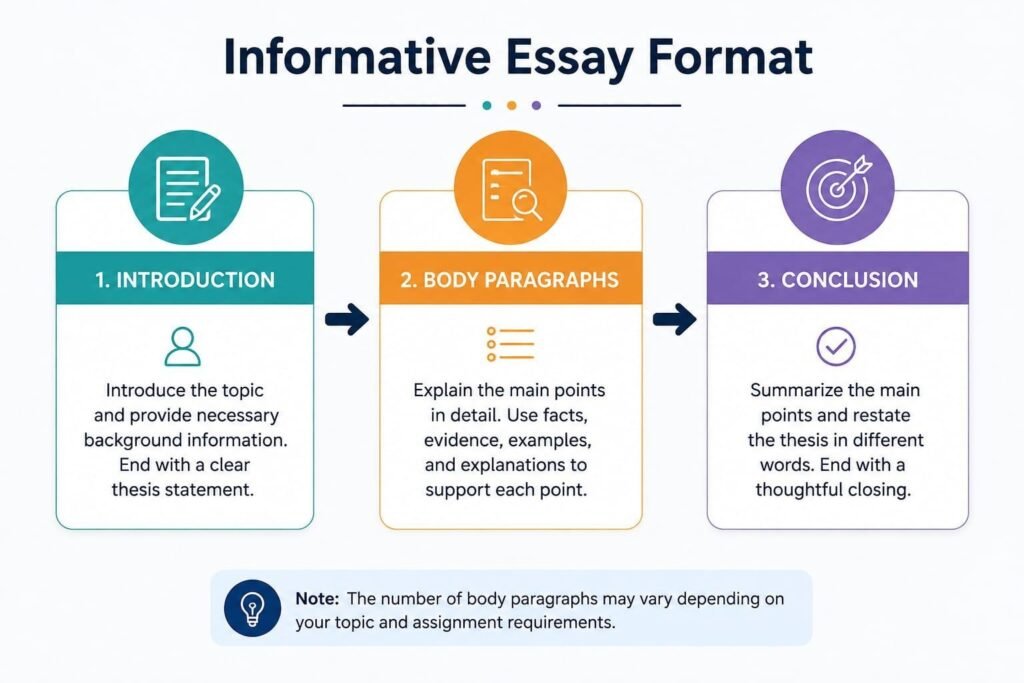
The basic informative essay format has three main parts: an introduction, body paragraphs, and a conclusion. However, the number of body paragraphs can change depending on the subject, word count, and assignment requirements. Adobe
Introduction
The introduction gives the reader enough context to understand the subject. It should lead naturally to your thesis statement, which tells the reader what the essay will explain.
A simple structure is:
Context → Topic → Thesis
Body Paragraphs
The body contains the actual explanation. Each paragraph should have one main focus and support it with relevant facts, examples, research, or other evidence.
A useful pattern is:
Topic sentence → evidence → explanation → transition
The explanation matters just as much as the evidence. Dropping a statistic into a paragraph without telling the reader what it shows leaves part of the job unfinished.
Conclusion
The conclusion brings the main ideas together. It should remind readers of what the essay explained without simply copying the introduction.
A five-paragraph essay is a useful starting structure, not a universal rule. Let the topic determine how much space each part needs.
How to Write an Informative Essay in 8 Steps
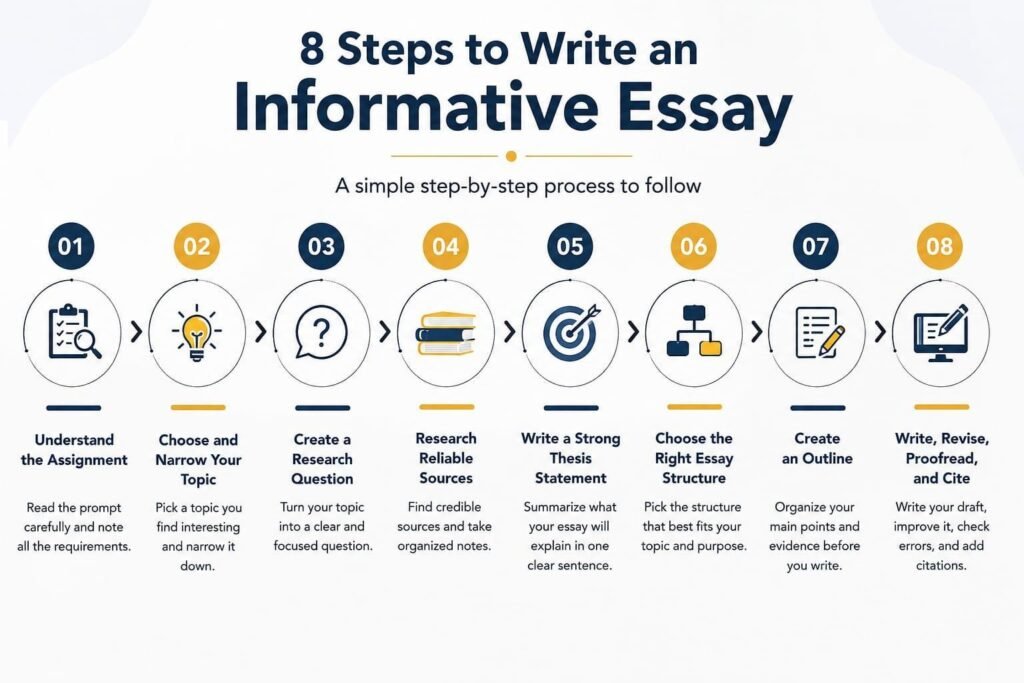
1. Understand the Assignment
Before opening a search engine or writing your first sentence, read the assignment carefully.
Look for the required topic, word count, number or type of sources, citation style, formatting rules, and any specific question your instructor wants you to answer. A strong essay can still lose marks if it answers the wrong question.
Pay attention to the wording of the prompt. Words such as explain, describe, compare, analyze, and how can point you toward different ways of organizing your information.
If the assignment gives you a question, keep that question visible while you research. It can stop you from collecting interesting information that has little to do with the actual task.
For example: If your assignment says “Explain the effects of social media on teenagers,” your job is not to argue that social media is good or bad. You need to explain the effects using relevant evidence.
2. Choose and Narrow Your Topic
A broad topic gives you too much to cover. A focused topic gives your essay a clear direction.
For example:
Too broad: Artificial intelligence
Better: Artificial intelligence in education
More focused: How AI tutoring tools can support personalized learning
If you are choosing your own topic, pick something you can explain properly within the required word count. Adobe also recommends narrowing the subject and researching it before building the essay.
A useful test is simple: Can I explain this topic thoroughly without having to discuss ten different subjects? If the answer is no, narrow it again.
3. Create a Research Question
Once you have a topic, turn it into a question.
Suppose your topic is student sleep. Instead of searching randomly for information, ask:
How does lack of sleep affect college students’ academic performance?
Now your research has a purpose.
This approach is particularly useful because your research question can guide the thesis later. Purdue Global uses a similar process by starting with a broad subject, narrowing it through a research question, and then using research findings to shape the thesis.
You do not need to know the final answer before researching. In fact, you may change your focus once you discover what reliable sources actually say.
4. Research Reliable Sources
Good informative writing depends on good information.
Start with sources that are appropriate for your subject, such as academic journals, books, government websites, universities, established organizations, and credible publications. Keep a record of the source details as you research. Waiting until the end to remember where every fact came from can turn citation work into a frustrating mess.
As you read, do more than copy interesting facts.
| Quick Source CheckWho published it?Is the author qualified?Is the information supported by evidence?Is it recent enough for your topic?Does the source show obvious bias? |
Also take notes in your own words. If you copy a sentence word for word, mark it clearly as a quotation and record the source immediately.
5. Write a Strong Thesis Statement
Your thesis gives the essay a central direction. In an informative essay, it should tell the reader what the essay will explain, rather than trying to force the reader to agree with your personal opinion.
Consider this example:
Weak:
- Social media is bad for students.
- That is a claim that sounds argumentative.
Stronger:
- Heavy social media use can affect students’ sleep, concentration, and study habits.
- The second version gives the essay something specific to explain.
Your thesis may also change during research. That is normal. If your sources show that your original idea was too broad or inaccurate, adjust the thesis instead of trying to make the evidence fit it.
A useful rule is to make your thesis specific enough to guide the body paragraphs without trying to cover the entire topic at once.
Example:
Topic: Sleep deprivation
Focus: College students
Thesis: Insufficient sleep can affect college students’ concentration, memory, and academic performance.
6. Choose the Right Essay Structure
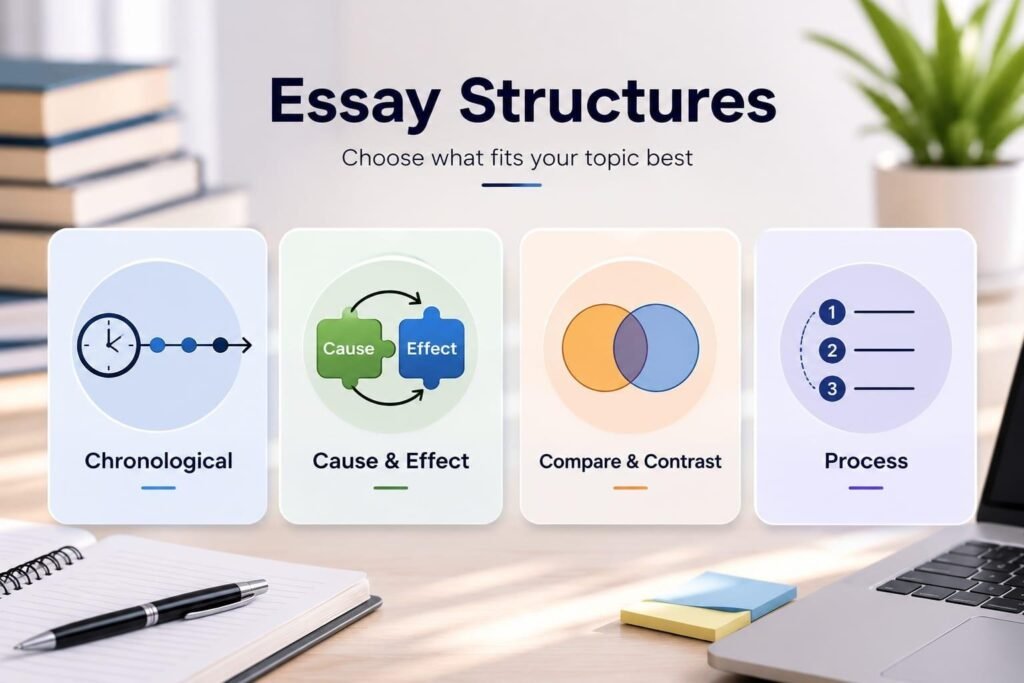
Not every topic should be organized in exactly the same way. Choose a structure that helps the reader understand the information naturally.
| Structure | Best for | Example |
| Chronological | Events that happen over time | The development of electric vehicles |
| Cause and effect | Explaining reasons and results | Causes of student sleep deprivation |
| Compare and contrast | Examining similarities and differences | Online and traditional learning |
| Process | Explaining how something works | How solar panels generate electricity |
| Classification | Dividing a subject into meaningful groups | Types of renewable energy |
Not sure which structure to choose? Start with the question your essay is answering. If you are explaining when events happened, use chronological order. If you are explaining why something happened, cause and effect may work better. If you are showing how something works, use a process structure.
Adobe notes that informative essays can be organized chronologically, as a process, through comparison, or by order of importance, depending on the topic.
The right structure should feel almost obvious once you understand your subject. If you are explaining how something happens, a process structure makes sense. If you are explaining why something happens, cause and effect may work better.
7. Create an Evidence-Based Outline
An outline is not meant to make your writing rigid. It gives you a place to decide what belongs where before you have twenty paragraphs competing for attention.
A basic outline could look like this:
Introduction
- Background
- Topic
- Thesis
Body Paragraph 1
- Main point
- Evidence
- What the evidence shows
- Connection to the thesis
Body Paragraph 2
- Main point
- Evidence
- What the evidence shows
- Connection to the thesis
Body Paragraph 3
- Main point
- Evidence
- What the evidence shows
- Connection to the thesis
Conclusion
- Main findings
- Restated central idea
- Final thought
Your outline can be shorter or more detailed. The important thing is that each section has a clear job. Adobe describes an outline as the “skeleton” of the essay because it lets writers organize information before developing the full draft.
8. Write, Revise, Proofread, and Cite
With your outline ready, start drafting. Do not stop every few minutes to perfect a sentence. Get the main ideas onto the page first.
Once the draft exists, the real improvement begins.
First, revise the content. Is every paragraph relevant? Does the evidence actually support the point? Are there gaps in your explanation?
Next, check the flow. Read the last sentence of one paragraph and the first sentence of the next. Does the transition make sense?
Then proofread for grammar, spelling, punctuation, and awkward wording.
Finally, check your citations. MLA, APA, Chicago, and other styles have different requirements, so follow the style your instructor or institution specifies.
How to Write Each Part of an Informative Essay
How to Write the Introduction
Do not spend half the introduction telling the reader that the topic is “very important.” Give them useful context instead.
For example, if your topic is student sleep, you might briefly introduce why sleep matters to learning, identify the specific issue you will discuss, and finish with your thesis.
The introduction should make the reader understand what the essay is about and what they are about to learn.
Example:
Sleep plays an important role in how students learn and function during the day. For college students, consistently getting too little sleep can create challenges that extend beyond feeling tired. Insufficient sleep can affect concentration, memory, and academic performance.
How to Write a Strong Body Paragraph
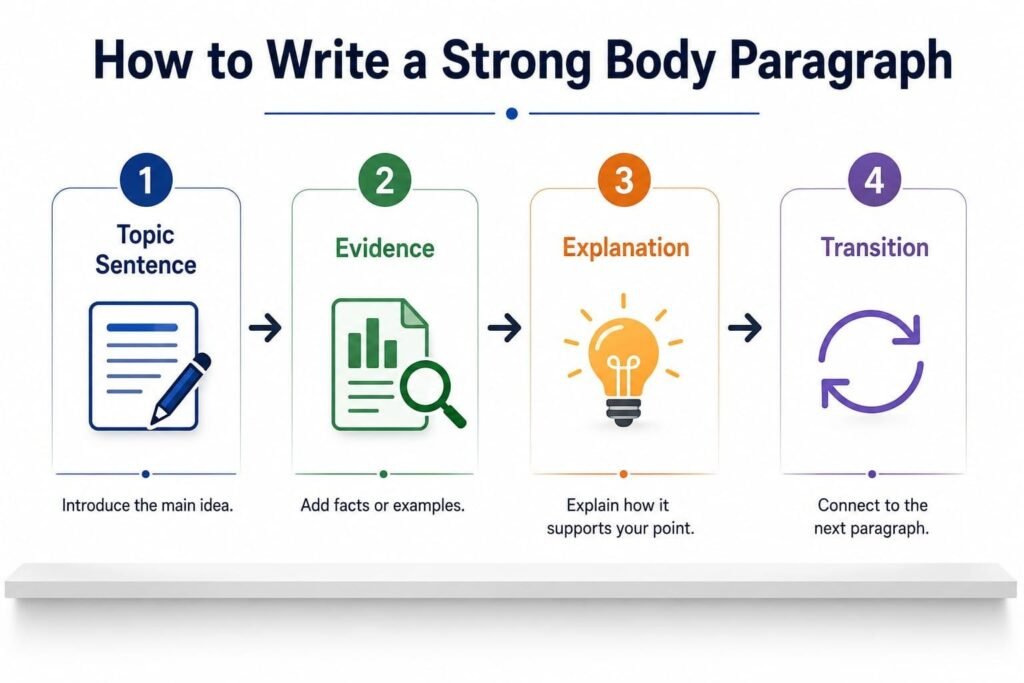
Start with a clear topic sentence.
Then bring in evidence. This might be a research finding, example, statistic, definition, or relevant fact.
After that, explain it.
That last part is often overlooked. Imagine you wrote:
Students who sleep less may have difficulty concentrating during the day.
Do not immediately jump to another unrelated fact. Explain how reduced concentration connects to the essay’s larger point. That extra explanation helps the reader follow your reasoning instead of forcing them to make the connection alone.
Purdue Global similarly emphasizes focused topic sentences, evidence, explanation, and transitions when developing informative paragraphs.
How to Write the Conclusion
A useful conclusion answers one question: What should the reader understand after finishing this essay?
Briefly bring together the main information you covered. Restate the central idea in fresh language, then finish with a relevant observation rather than introducing a completely new argument.
Informative Essay Example

Imagine the assignment is:
Explain how poor sleep can affect college students.
You could develop it like this:
Research question:
How can insufficient sleep affect college students’ academic performance?
Working thesis:
Insufficient sleep can affect college students’ concentration, memory, and daily academic performance.
Possible outline:
- Introduction: Why sleep matters for students
- Body 1: Effects on concentration
- Body 2: Effects on memory and learning
- Body 3: Effects on academic routines
- Conclusion: What the research shows about sleep and student performance
Notice that the outline is not simply a collection of facts. Each section answers part of the research question.
Sample Body Paragraph:
Lack of sleep can make it harder for college students to maintain concentration during lectures and study sessions. When students do not get enough rest, they may struggle to stay focused on tasks for long periods. This can make studying less effective and may affect how well they understand and remember new information.
Common Mistakes to Avoid
Even a well-researched essay can feel weak if the information is poorly handled. Watch for these problems:
- Choosing a topic that is too broad. A huge subject usually produces shallow coverage.
- Using a persuasive thesis. Your goal is to explain, not pressure the reader into accepting your opinion.
- Collecting facts without explaining them. Evidence needs context.
- Using unreliable sources. A polished paragraph cannot fix weak research.
- Putting several unrelated ideas in one paragraph. Give each paragraph a clear focus.
- Forcing every essay into five paragraphs. The topic and assignment should determine the length.
- Ignoring citations until the last minute. Record source information while researching.
- Editing only grammar. A grammatically correct essay can still have weak organization or unclear ideas.
How to Make an Informative Essay More Engaging
An informative essay can be factual without becoming boring. Use relevant examples, specific details, clear explanations, and smooth transitions to keep readers interested. Avoid exaggerated language or personal opinions that distract from the topic.
- Use relevant examples
- Add specific facts
- Explain evidence clearly
- Use smooth transitions
- Keep an objective tone
Citation and Formatting Tips
The exact formatting of an informative essay depends on your assignment.
Purdue OWL provides detailed guidance for different citation styles, including APA, MLA, and Chicago. These styles can differ in how they handle in-text citations, reference pages, headings, and other formatting details.
Before submitting, check the assignment instructions rather than assuming that one format applies to every class.
Also make sure that information borrowed from a source is properly credited. This includes direct quotations, paraphrased ideas, statistics, and other information that is not your own.
Final Informative Essay Checklist
Before you submit your essay, run through this quick check:
𐀀Is my topic focused enough?
𐀀Does my research answer a clear question?
𐀀Is my thesis specific and informative?
𐀀Does my structure fit the topic?
𐀀Does each body paragraph have one main focus?
𐀀Have I explained my evidence?
𐀀Is my tone objective?
𐀀Are my sources credible?
𐀀Have I cited borrowed information correctly?
𐀀Does the conclusion bring the main ideas together?
𐀀Have I checked grammar, spelling, and formatting?
FAQs
How do you start an informative essay?
Start by understanding the assignment and choosing a focused topic. Then turn the topic into a research question, gather reliable information, and develop a working thesis. Your introduction should give the reader useful context before clearly stating what the essay will explain.
What is the format of an informative essay?
The basic informative essay format includes an introduction, body paragraphs, and a conclusion. The number and organization of body paragraphs depend on the topic and assignment. You can use chronological, cause-and-effect, comparison, process, or another logical structure when appropriate.
How many paragraphs should an informative essay have?
There is no universal number. A short assignment may use the familiar five-paragraph structure, while a longer essay may need more body paragraphs. Choose the number of paragraphs based on how much information is needed to explain the topic properly.
What makes a good thesis for an informative essay?
A good thesis clearly tells the reader what the essay will explain. It should be focused enough to guide the body paragraphs without turning into a personal argument. Your thesis can also be refined after you complete your research.
Can you use first person in an informative essay?
It depends on the assignment. Some instructors allow first person, while others prefer a more formal third-person style. If your instructions do not specify, use a clear academic style and avoid unnecessary personal statements that do not contribute to the explanation.
What is the difference between an informative and argumentative essay?
An informative essay explains a topic using objective information, while an argumentative essay takes a position and uses evidence to support that position. The difference is mainly in purpose. Informative writing helps readers understand a subject, while argumentative writing tries to convince them of a claim.
What should you avoid in an informative essay?
Avoid unsupported claims, excessive personal opinions, unreliable sources, unrelated information, and evidence without explanation.
Conclusion
Learning how to write an informative essay becomes much easier when you stop thinking of it as a formula and start treating it as a process of answering a clear question.
Choose a manageable topic, narrow it down, research trustworthy sources, build a thesis from what you discover, and organize the information in a structure that suits the subject. Then write your draft, explain your evidence, revise the ideas, and finish with careful proofreading and citations.
A strong informative essay does not try to sound complicated. It makes the reader understand something they did not understand as clearly before. That is the real measure of successful informative writing.